
Nyugwe Forest National Park


Overview
Discover Nyungwe Forest National Park, one of the best places in Rwanda to see primates. This thorough travel guide offers vital information to assist you in organizing a fulfilling trip. Officially gazetted in 2004, Nyungwe is the second-largest national park in Rwanda, behind Akagera. The park is currently between 1,600 and 2,950 meters above sea level and covers around 970 square kilometers.
Nyungwe, which is in the Southern Province of Rwanda, is near Lake Kivu and the borders of Burundi and the Democratic Republic of the Congo. Rich in biodiversity, the park is home to a diverse range of plant, animal, and bird species. Thirteen primate species, over forty amphibians, more than 310 bird species, and almost forty reptile species are among the remarkable variety of wildlife found in Nyungwe.
Key Attractions in Nyungwe Forest National Park (Rwanda)
The Diverse Wildlife of Nyungwe
About 85 species
of mammals, many of which are primates, may be found in Nyungwe Forest National Park. Red-tailed monkeys, an estimated 500 chimpanzees, silver monkeys, around 400 colobus monkeys, olive baboons, vervet monkeys, blue monkeys, and grey-cheeked mangabeys are just a few of the many kinds of primates found in the park.
The bird species
There are over 310 distinct bird species in Nyungwe Forest National Park, including 29 species that are indigenous to the Albertine Rift. The Archer’s robin-chat, Shelley’s crimson-winged starling, bar-tailed trogon, Kungwe apalis, Doherty’s bushshrike, barred long-tailed cuckoo, beautiful francolin, Rwenzori turaco, blue-headed coucal, Kivu ground thrush, and Congo bay owl are among the prominent species seen in the park’s many ecosystems. Nyungwe is a veritable bird lover’s dream, with several more species often sighted, such as the African black duck, Chapin’s flycatcher, great blue turaco, black saw-wing, and red-throated alethe.
The floral species of Nyungwe
Visitors may find around 200 distinct tree species, including towering mahogany and holstii trees, and about 248 orchid species at Nyungwe Forest National Park. In addition to its vast sub-alpine and montane forest landscapes, the park is well-known for its charming bamboo groves, providing nature enthusiasts with a rich and varied natural setting.
Activities in Nyungwe
The wide range of safari adventures available during a visit to Nyungwe Forest National Park includes tracking colobus monkeys, trekking or observing chimpanzees, birdwatching, guided forest hikes, and cultural visits to local communities.
Chimpanzee trekking/tracking
Chimpanzee trekking is the highlight of each primate enthusiast’s trip to Nyungwe Forest National Park. A well-established group of habituated chimpanzees may be found in the park, and Uwinka, Cyamudongo, and Kitabi are excellent places to start a trip. The hiking experience normally lasts two to five hours, and visitors must meet at the briefing location by five in the morning. The day starts with an overview of the safety regulations and requirements for monitoring chimpanzees, after which a knowledgeable ranger guide is assigned. Currently, the park entrance fee and chimpanzee tracking permit cost $250 USD.
Colobus monkey trekking experience
More than 400 colobus monkeys may be seen in Nyungwe Forest National Park, and many of them have become used to people. Under the supervision of a skilled Nyungwe ranger, visitors may take pleasure in strolling through the verdant jungle while looking for these intriguing primates. The colobus monkey journey offers a chance to see their unique habits and take striking pictures. Both morning and afternoon trek times are available, starting at 8:00 a.m. In addition to the $100 park admission charge, the colobus monkey tracking ticket costs $40. There is also a good chance that you may come across other primate species along the way, such l’Hoest’s monkeys.
Bird-watching and nature walk.
Some of the most captivating chances for nature hikes and birding may be found at Nyungwe Forest National Park. African crested flycatchers, red-backed shrikes, Rwenzori turacos, Archer’s robin-chat, Lagden’s shrikes, lesser gray shrikes, and many more species are among the many birds that tourists may see on these guided excursions, making it a birdwatcher’s dream.
Some of the popular nature walking trails in Nyungwe Forest National Park include the Ngabwe Trail (4.7 km), Bigugu Trail (13.2 km), Karamba Trail (4 km), Igishigishigi Trail (2.1 km), Uwinka Trail (17.8 km), Umuyove Trail (5.5 km), Congo Nile Divide Trail (42 km), Isumo Waterfall Trail (10.6 km), as well as the Irebero, Imbaraga, Umugote, and Muzimu hiking routes. These trails offer a variety of distances and scenic experiences for both casual walkers and avid hikers.
Guided canopy walk
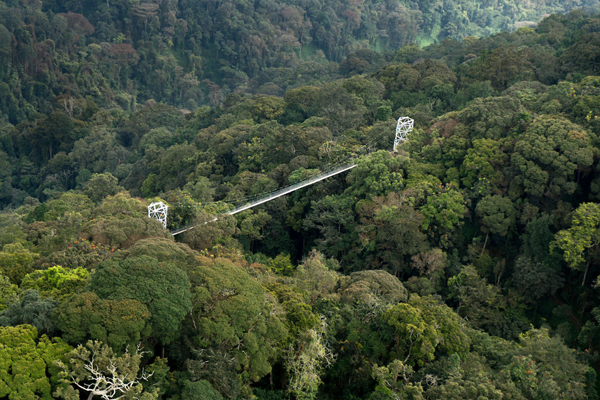
One of the best places in East Africa to have a memorable canopy walk experience is Nyungwe Forest National Park. With its 200-meter length and elevation of around 60 meters above the forest floor, the canopy walkway provides breathtaking views of the rainforest. Starting at the Uwinka Visitor Center and escorted by an experienced guide, a full circuit of the path typically takes two hours to complete.
Community visits
Visitors may establish personal connections with locals by taking part in a guided community tour in Nyungwe Forest. Visitors may participate in craft-making and culinary classes, watch traditional dance performances, and learn about the region’s unique cultures and customs. Visitors may learn more about tea farming and follow the process from planting to the final product by visiting neighboring tea estates like the Gisakura Tea Estate or Gisovu Tea Estate.
Best Time to Visit Rwanda’s Nyungwe Forest National Park
Safaris in Nyungwe Forest can be arranged and booked throughout the year; however, the dry season provides the most favorable weather for visitors to enjoy guided chimpanzee treks, canopy walks, and hiking excursions. The primary dry period in Nyungwe spans June through September, while a shorter dry season occurs from December to February. These months offer the best conditions for most safari activities compared to the wet season, which runs from March to May and October to November.
Where to stay during a safari in Nyungwe
Accommodation options in and around Nyungwe Forest National Park cater to all preferences, ranging from budget-friendly to mid-range and luxury lodges. Notable places to stay include Nyungwe Top View Hill Hotel, Kitabi Eco-Centre, Gisakura Guesthouse, One&Only Nyungwe House, Nyungwe Nziza Eco-Lodge, and several others, providing visitors with comfortable and convenient bases for their forest adventures.
How to reach Nyungwe Forest (from Kigali)
Accessing the National Park of Nyungwe Forest
It is safe to go by plane or by vehicle to Nyungwe National Park. Depending on traffic and driving pace, the travel from Kigali takes around 6–7 hours by road, with Butare/Huye acting as a handy stopover. By automobile, visitors can easily get to Nyungwe from Volcanoes National Park in around six hours. Faster options include flights from Kigali that arrive at Kamembe Airport, after which it’s a 40-kilometer drive to the park.
In conclusion
To discover the delights of Nyungwe Forest National Park, schedule your safari in Rwanda. Discover the park’s stunning scenery and have unforgettable interactions with animals, such as your favorite monkeys and bird species. To plan your remarkable Nyungwe Forest journey, get in touch with Maranatha Tours & Travel.

Get A Questions
Embrace the journey of reconnecting with nature and the wild spirit within yourself.
Experience Tranquility, Discover Your Perfect Nature Retreat
your door to exceptional natural life encounters and gorilla trekking experiences in East Africa.